Evan Shipman
A Moveable FeastEvan Shipman emerges in Ernest Hemingway’s recollections as a fine poet who cared about horses, writing, and painting, but did not care whether his own poems were published. At the Closerie des Lilas, his attentiveness to literary questions and his pleasure in an unresolved mystery set him apart from a café being reshaped to attract paying customers. His remarks join two facts that never quite reconcile: artistic ambition can be refused, but a writer still has to live.
Identity and Introduction
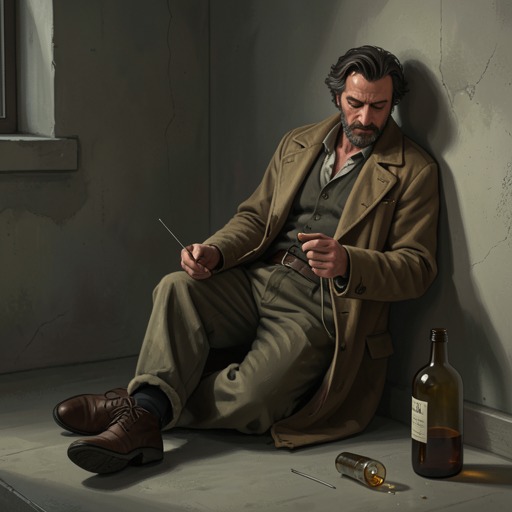
Hemingway finds Shipman waiting on the terrace of the Closerie des Lilas. The portrait is exact and unsentimental: Shipman is tall, pale, and thin, in a white shirt worn dark at the collar, a carefully knotted tie, and a wrinkled grey suit. His fingers are more stained than his hair; his nails are dirty. He holds a loving, deprecatory smile tightly, as if not wanting to show his bad teeth. The detail makes his appearance part of the encounter, not a polished introduction: care in the knot of his tie sits beside the wear of his clothes and hands. He greets Hemingway warmly, calling him Hem, and rises to meet him.
Shipman is identified not only by his poetry but by the range of things that held his interest. He knew and cared about horses, writing, and painting. The recollection does not give him a publication record, a career history, or a declared programme; instead, it establishes a working identity through those interests and through the way he speaks with Hemingway. The later description of him as a poet who truly did not care whether his poems were published sharpens this portrait without turning him into someone indifferent to art itself.
Literary Conversation
On the empty terrace, the two men turn to Dostoyevsky. Hemingway asks how a writer can write so badly and yet make a reader feel so deeply. Shipman rejects the easy explanation that the effect comes from translation: “It can’t be the translation,” he says, pointing out that the same translator makes Tolstoi read well. The brief exchange reveals a shared concern with the difference between literary execution and emotional force. Shipman does not simply praise the effect or dismiss the difficulty; he tests an explanation against another writer translated by the same person.
The conversation presents him as a reader willing to take awkwardness seriously rather than equating good writing with smooth prose. His answer is measured, but it keeps the question open: a translation that succeeds with Tolstoi cannot by itself explain why Dostoyevsky’s writing feels different. The scene offers no final theory, and Shipman’s response does not pretend to supply one. That restraint fits the larger portrait of a poet drawn to questions whose value may lie partly in their resistance to a neat solution.
The Closerie des Lilas and Its Changing Public
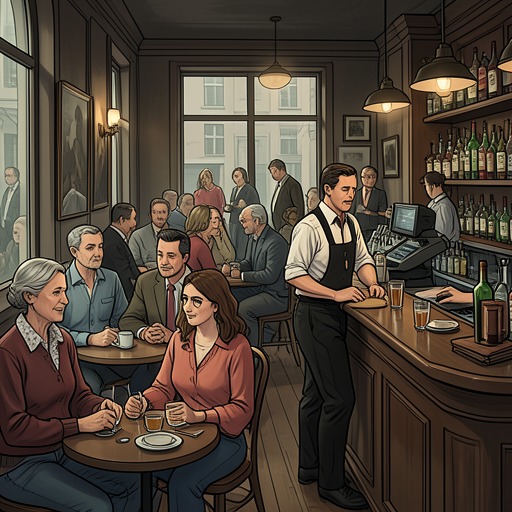
Shipman also tells Hemingway that the café is in trouble because its management is changing. The new owners want a clientele that will spend money and plan to install an American bar. The waiters, he says, are to wear white jackets and have been ordered to shave their mustaches. Hemingway objects that the change cannot be imposed on André and Jean; Shipman replies that it should not be, but that it will be. His account makes the transformation concrete: a change in the café’s intended clientele reaches down to uniforms and the waiters’ faces.
The episode places Shipman between an older social world and a commercial redesign. He does not claim that the staff can prevent it; his answer distinguishes what ought to happen from what will happen. The café’s new owners seek customers with money, while the details Shipman relays concern the people already working there. His report therefore gives the change a human scale without suggesting that he has the power to reverse it. In the same setting, the poet who does not care about publication is alert to a different pressure: the conversion of a familiar meeting place into a more explicitly commercial one.
Mystery, Publication, and Sustenance
Shipman’s clearest statement of his artistic values comes in Hemingway’s recollection of Ralph Cheever Dunning’s troubles. After an unsuccessful effort by Hemingway and the concierge to intervene, the poets organized by Ezra Pound eventually rallied to Dunning’s aid. The episode remained unresolved in important respects: Hemingway did not know why Dunning had thrown milk bottles at him, and the jar he had kept wrapped in waxed paper and hidden in an old riding boot was gone when he and Shipman later cleared his belongings from the apartment. Shipman found symbolic possibility in the report that Dunning had gone onto the roof and categorically refused to come down, but Hemingway says Shipman believed the matter should remain a mystery.
Shipman’s response is not to claim that the incident has one decipherable meaning. He values the uncertainty itself: “We need more true mystery in our lives, Hem,” he says. He names the completely unambitious writer and the really good unpublished poem as things missing from the present moment, then adds, “There is, of course, the problem of sustenance.” The qualification is crucial. His ideal of work free from the hunger for recognition does not erase the need to live; the unpublished poem may be artistically whole and still leave its maker with a practical problem. In Shipman, artistic modesty and material necessity remain side by side, while the Dunning episode gives his preference for mystery a lived, unresolved example.